
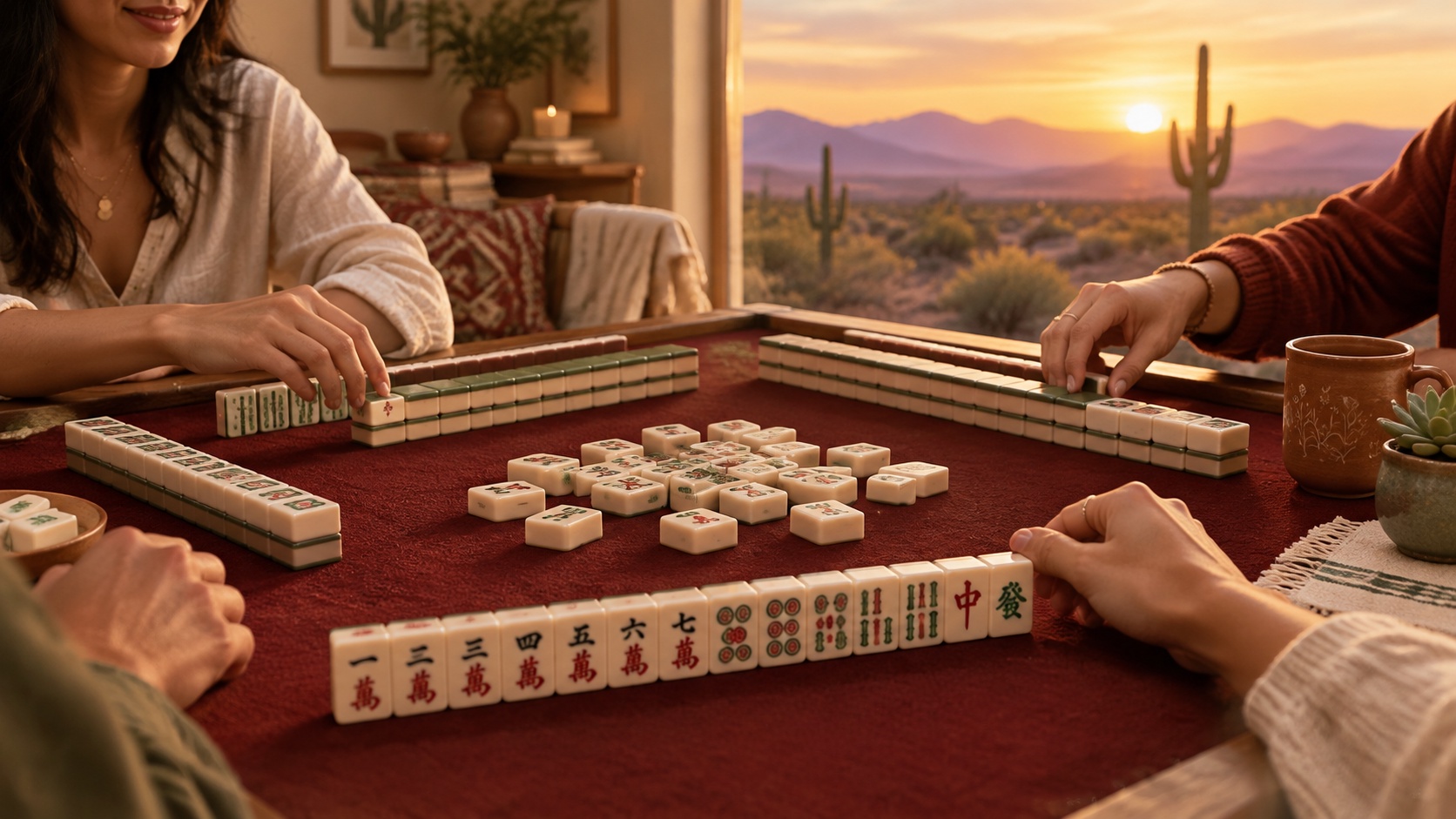
Mahjong tiles and friends at an Arizona game table

AZ Mahjong · Learn & play

Mahjong playing styles

One family of tiles, many ways to play. Most styles combine numbered Dots, Bamboo and Characters with honor tiles, but hand structure, calls and scoring vary. Usually four players share a table; three-player versions also exist.

Style variants

American Mahjong

Tile set
Usually 152 tiles, including eight jokers and eight flowers.
Winning hand
Hands follow a current annual published hand list; most winning hands use 14 tiles.
What sets it apart
The Charleston exchanges tiles before play. Jokers work in groups of three or more, not singles or pairs; sequences are not freely built as in other styles.
Scoring
Use the value on the chosen hand list and its payment rules. Self-draw and exposed/concealed hands affect payment.

Club notes & tips

Confirm which year and publisher the table uses before starting. Bring a legitimately purchased hand list; we do not reproduce it.

Rules reference ↗

Japanese Riichi

Tile set
Usually 136 tiles; many sets include red fives as replacements.
Winning hand
Four groups and a pair is standard, with special hands such as seven pairs and thirteen orphans.
What sets it apart
You need at least one yaku to win. Riichi rewards closed hands; furiten limits discard wins. Dora add value but do not count as yaku.
Scoring
Count han and fu, then use a payment table. Dealer/non-dealer, ron/tsumo, limits and round bonuses change payments.

Club notes & tips

Learn riichi, tanyao and yakuhai first. Track your own discards carefully; a tempting tile may not be legal to win on.

Rules reference ↗

Hong Kong Old Style

Tile set
Typically 144 tiles with flowers and seasons; some tables omit bonuses.
Winning hand
Four groups and a pair; accepted special hands depend on the table.
What sets it apart
A straightforward fan-based style emphasizing triplets, suit patterns and honors. Minimum fan and flower treatment vary by house rules.
Scoring
Agree the minimum fan, fan-to-payment table and limit before play; there is no single universal payout chart.

Club notes & tips

Ask about chicken hands, the fan minimum and whether flowers contribute. Small house-rule differences can change what is a winning hand.

Rules reference ↗

Chinese Competition (MCR)

Tile set
144 tiles, including flowers.
Winning hand
Four groups and a pair is common, alongside recognized special patterns.
What sets it apart
A standardized competition system with 81 scoring patterns and an eight-point minimum, excluding flower points.
Scoring
Add eligible pattern points under combination/exclusion rules. A discard winner receives eight base points from each opponent plus hand points from the discarder.

Club notes & tips

Use the official scoring reference. Do not stack patterns that the combination rules exclude, and do not rely on flowers to reach eight points.

Rules reference ↗

Sichuan Mahjong

Tile set
Common blood-battle rules use 108 suited tiles, without winds, dragons or flowers.
Winning hand
Commonly four groups and a pair; seven pairs may also be recognized.
What sets it apart
Many tables choose a missing suit that must be cleared, prohibit chow calls and continue after the first winner until multiple players win.
Scoring
Fan multipliers, kong payments and end-of-hand penalties depend on the agreed blood-battle or blood-flow rules.

Club notes & tips

Choose a missing suit deliberately and clear it early. Confirm whether winners stop playing or continue; both approaches exist.

Rules reference ↗

Taiwanese Mahjong

Tile set
Usually 144 tiles including flowers and seasons.
Winning hand
Five groups and a pair: 16 tiles in hand before winning, 17 in a completed hand.
What sets it apart
The larger hand creates more combinations. Dealer streaks, flowers and tai patterns are central, with many local variations.
Scoring
Agree the base amount and payment per tai, plus dealer and streak bonuses. Payments are not interchangeable with 13-tile styles.

Club notes & tips

Count five groups, not four. Confirm dealer bonuses and flower rules before the first wall is built.

Rules reference ↗

Quick-reference tiles & scoring

Know your tiles

🀙 🀚 🀛Dots · numbers 1–9
🀐 🀑 🀒Bamboo · numbers 1–9; the one is often a bird
🀇 🀈 🀉Characters · numbers 1–9
🀀 🀁 🀂 🀃Winds · East, South, West, North
🀄 🀅 🀆Dragons · Red, Green, White

Chow: three consecutive numbers in one suit. Pung: three identical tiles. Kong: four identical tiles, usually followed by a replacement draw. Pair: two identical tiles.

Before you call mahjong

  • American: match an allowed annual hand exactly; check joker and concealed-hand restrictions.
  • Riichi: at least one yaku, then han + fu and a payment table. Dora alone are not enough; check furiten.
  • MCR: at least eight pattern points without flowers; apply exclusions before adding points.
  • Hong Kong / Sichuan / Taiwanese: confirm the local minimum, special hands and payment schedule before playing.
  • Standard four-group hands use 13 tiles before the win and 14 when complete; kongs and special hands alter physical counts. Taiwanese uses five groups.

This is a quick reference, not a full rulebook. Club placement points below are separate from any variant’s game scoring.

Player experience & standings

Organizers set skill tiers. Recorded finishes earn 4, 3, 2 or 1 club points for 1st–4th. Win badges mark 1, 10, 25 and 50 wins; these do not replace an organizer's skill assessment.

RankPlayerExperienceWinsGamesPoints